
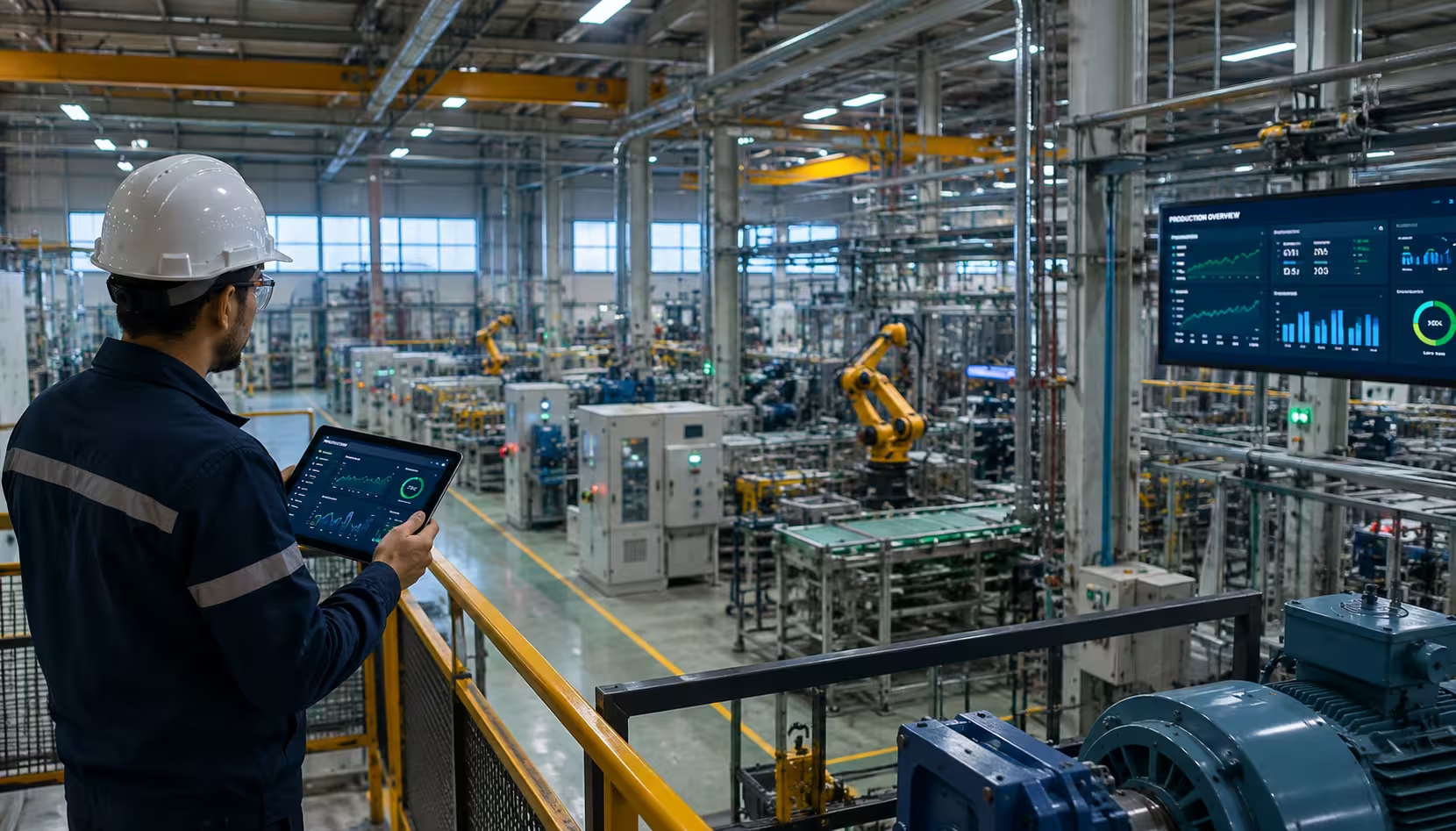
The Technology Behind Industrial AI: Exploring the Systems and Infrastructure that Enable Industrial AI

Industrial AI represents the convergence of artificial intelligence with the rugged, mission-critical environments of manufacturing, energy, utilities, and other heavy industries.

Unlike consumer AI, Industrial AI operates at scale amid harsh conditions, legacy systems, and the need for ultra-high reliability.

It powers predictive maintenance, autonomous optimization, quality control, and supply chain resilience—driving what many call Industry 4.0 and the next generation of smart manufacturing.

The foundation of Industrial AI is not just algorithms. It is the underlying infrastructure of connected devices, real-time data flows, hybrid computing architectures, and digital representations of physical operations.

This article explores the key technologies that make Industrial AI possible and how they work together to create intelligent industrial systems.

Industrial IoT (IIoT): The Nervous System of Smart Industry

Industrial IoT (IIoT) applies IoT principles to industrial environments by connecting machines, sensors, and systems to collect, exchange, and act on operational data.

Unlike consumer IoT, IIoT prioritizes reliability, security, and integration with existing Operational Technology (OT) systems.

By extending traditional PLCs and automation systems with connected sensors and communication networks, IIoT creates the foundation for Industrial AI.

Key Benefits of IIoT

  • Predictive maintenance through continuous equipment monitoring.
  • Operational efficiency through real-time optimization.
  • Improved safety and product quality.
  • Enterprise-wide visibility across multiple sites and facilities.

However, organizations must address cybersecurity risks, legacy system integration challenges, and growing data volumes to unlock the full value of IIoT.

Sensors and Connected Assets: The Eyes and Ears of Industrial AI

At the heart of every Industrial AI initiative are sensors and connected assets.

These devices capture operational data from machines, equipment, and processes by measuring variables such as vibration, temperature, pressure, flow, humidity, and electrical current.

Connected assets transform traditional equipment into intelligent, data-generating systems capable of supporting advanced analytics and machine learning applications.

Industrial AI Applications Enabled by Connected Assets

  • Real-time condition monitoring.
  • Asset tracking and inventory optimization.
  • Energy management and sustainability initiatives.
  • Predictive maintenance and failure prediction.

The transition from periodic inspections to continuous AI-driven monitoring significantly improves Overall Equipment Effectiveness (OEE) and operational reliability.

Edge Computing vs. Cloud Computing

Industrial environments require both real-time decision-making and large-scale analytics.

This requirement has led to the adoption of hybrid edge-cloud architectures.

Edge Computing

Edge computing processes data close to the source, often on industrial gateways, embedded devices, or on-premise infrastructure.

Its primary advantages include low latency, reduced bandwidth requirements, improved security, and the ability to operate even when connectivity is limited.

Common use cases include anomaly detection, machine protection, and autonomous process control.

Cloud Computing

Cloud platforms provide scalable storage, advanced analytics, machine learning model training, and enterprise-wide visibility across facilities.

They enable organizations to aggregate data, perform historical analysis, and continuously improve AI models.

The Hybrid Reality

Most Industrial AI deployments combine both approaches.

Edge systems perform real-time inference and operational decisions, while cloud platforms handle large-scale data management and model development.

This hybrid architecture balances speed, scalability, and operational resilience.

SCADA, MES, ERP, and AI Integration

Industrial operations are typically built on several interconnected systems that manage everything from equipment control to enterprise planning.

SCADA

Supervisory Control and Data Acquisition (SCADA) systems provide real-time monitoring and control of industrial equipment and processes.

MES

Manufacturing Execution Systems (MES) manage production workflows, quality tracking, scheduling, and operational performance.

ERP

Enterprise Resource Planning (ERP) systems support business functions including inventory management, finance, procurement, and supply chain planning.

Where AI Creates Value

  • Predictive insights within SCADA environments.
  • AI-driven scheduling and quality optimization in MES.
  • Demand forecasting and inventory optimization in ERP systems.

By connecting these traditionally separate layers, organizations create a digital thread that improves visibility and decision-making from the shop floor to the boardroom.

Data Historians and Industrial Data Platforms

Data historians serve as the memory layer of industrial operations.

They collect and store large volumes of time-series data generated by sensors, PLCs, SCADA systems, and connected assets.

Modern Industrial Data Platforms extend these capabilities by providing contextualization, asset modeling, cloud integration, and AI-ready data architectures.

Why This Matters for Industrial AI

Industrial AI depends on both historical and real-time operational data.

Without clean, contextualized, and accessible data, even the most advanced AI models struggle to deliver reliable insights.

Data quality remains one of the most important success factors in Industrial AI deployments.

Digital Twins and Virtual Operations

A Digital Twin is a virtual representation of a physical asset, process, production line, or entire facility.

Powered by real-time operational data, Digital Twins help organizations simulate, predict, and optimize industrial performance.

Levels of Digital Twin Maturity

  • Asset Twins.
  • Process Twins.
  • Factory Twins.
  • Enterprise Twins.

Industrial AI Applications

  • Predictive simulation and scenario testing.
  • Real-time anomaly detection.
  • Production optimization.
  • Operator training in virtual environments.
  • Closed-loop autonomous operations.

Digital Twins enable organizations to experiment, optimize, and innovate without disrupting physical operations.

Challenges and the Road Ahead

While Industrial AI offers tremendous potential, several challenges continue to slow adoption.

  • Cybersecurity and OT/IT convergence risks.
  • Legacy brownfield integration.
  • Industrial AI talent shortages.
  • Data governance and standardization.
  • ROI justification and executive alignment.

As Industrial AI matures, organizations are increasingly investing in edge intelligence, 5G connectivity, Agentic AI, sustainability-focused analytics, and open industrial data platforms.

Building Industrial AI Teams for the Future

Technology alone does not determine the success of Industrial AI initiatives.

Organizations require engineers, architects, and leaders who understand industrial operations, automation systems, cloud platforms, data engineering, and artificial intelligence.

At Propellence Consulting, we help manufacturers, industrial technology companies, and engineering organizations build high-impact teams across Industrial AI, Smart Manufacturing, Industry 4.0, Robotics, OT/IT Integration, and Digital Transformation.

From Industrial AI Architects and Data Engineers to Engineering Leaders and Digital Transformation Executives, we help organizations secure the talent required to scale Industrial AI successfully.

Conclusion: Building the Intelligent Industrial Future

The technology stack behind Industrial AI—IIoT, connected assets, edge computing, cloud platforms, industrial data systems, and digital twins—creates a living ecosystem capable of learning, adapting, and improving continuously.

Industrial AI does not replace human expertise. It amplifies it.

Organizations that invest in strong data foundations, connected infrastructure, and specialized talent will be best positioned to unlock higher productivity, improved resilience, and long-term competitive advantage.

The future of manufacturing belongs to organizations that can transform industrial data into operational intelligence.