
Robotics Industry Trends 2026: What’s Driving Growth and What Leaders Must Address
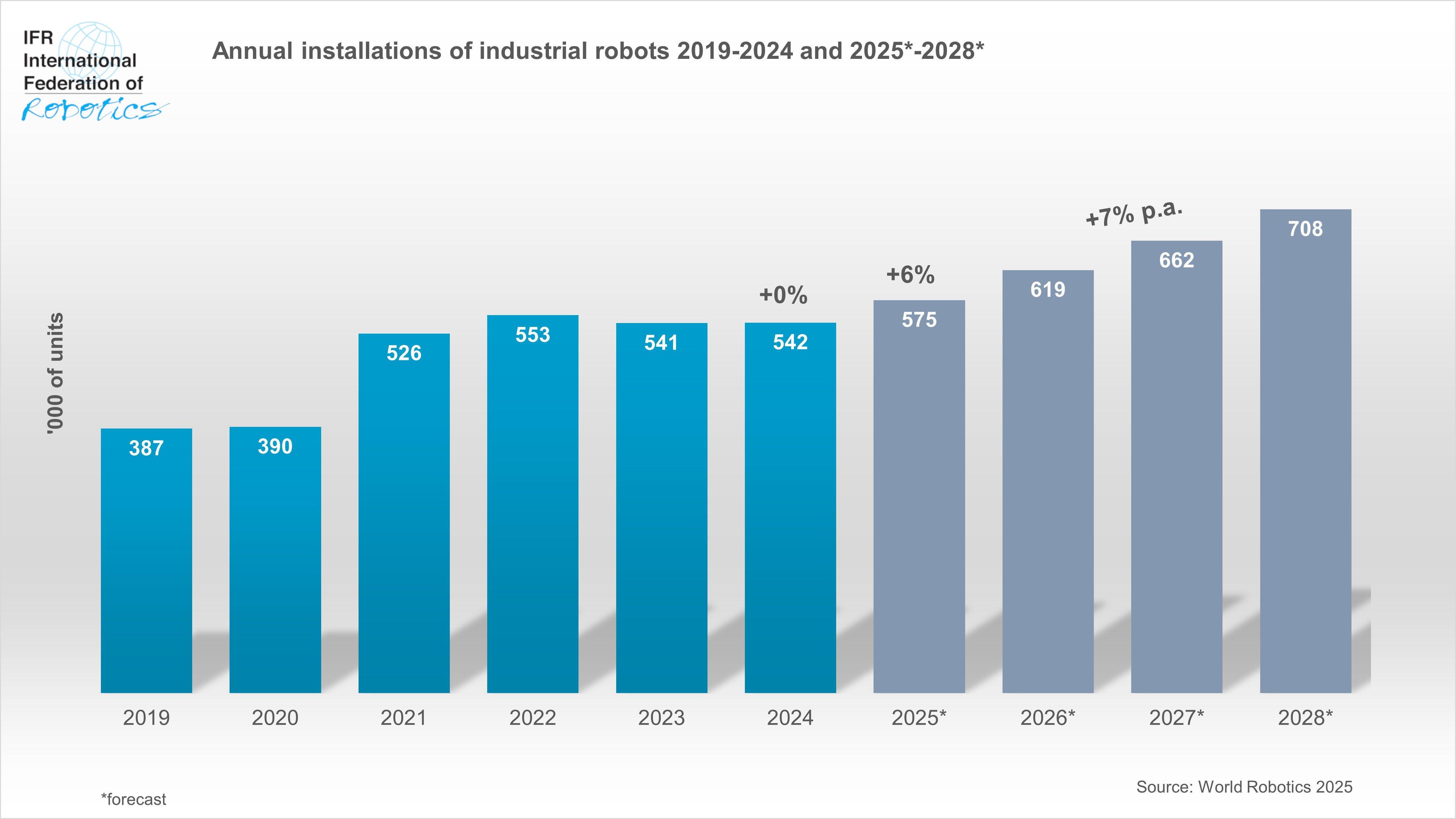
The robotics sector continues its steady expansion even as economic conditions remain uneven. According to the International Federation of Robotics (IFR) World Robotics 2025 report, 542,000 industrial robots were installed globally in 2024—more than double the volume of a decade earlier and the second-highest annual figure on record. The worldwide operational stock reached approximately 4.66 million units, up 9% year-over-year. Asia accounted for 74% of new deployments, with China alone representing 54% (295,000 units).
Market-value estimates for the broader robotics sector (industrial, service, and emerging categories) vary by scope, but multiple sources place the 2025 market in the $50–80 billion range, with projections pointing to continued double-digit compound growth through the end of the decade. Industrial robot installation value alone hit a record $16.7 billion.
For engineering and manufacturing leaders, the numbers matter less than the structural shifts underneath them: greater autonomy through AI, diversification beyond automotive, rising demand for flexible systems, and a persistent shortage of specialized engineering talent. This article examines the dominant trends for 2026, practical applications, limitations, and the organizational capabilities required to capture value.
Market Snapshot: Where Demand Is Concentrated
- China remains the clear volume leader. Domestic suppliers captured 57% of the Chinese market in 2024—up sharply from roughly 28% a decade earlier—and the country’s operational stock surpassed 2 million units.
- Electronics overtook automotive as the largest application sector by installations in 2024.
- Non-automotive demand continues to rise. In North America, first-half 2026 data from the Association for Advancing Automation (A3) showed growth in semiconductors/electronics, life sciences, food and consumer goods, and metals, while automotive OEM orders softened.
- Robot density continues to climb: Korea leads at 1,220 robots per 10,000 manufacturing employees, followed by Singapore, China, Germany, and Japan.
IFR projects global industrial robot installations to rise approximately 6% to 575,000 units in 2025 and to surpass 700,000 annually by 2028.
Five Key Robotics Trends Shaping 2026
1. AI and Autonomy in Robotics
Analytical AI (pattern recognition and predictive maintenance) is now being joined by more generative and agentic capabilities that allow robots to adapt to new environments and generate intent-based actions. The practical result is higher autonomy for tasks that previously required extensive pre-programming or frequent human intervention. Vision-Language-Action models are appearing in a growing share of new deployments.
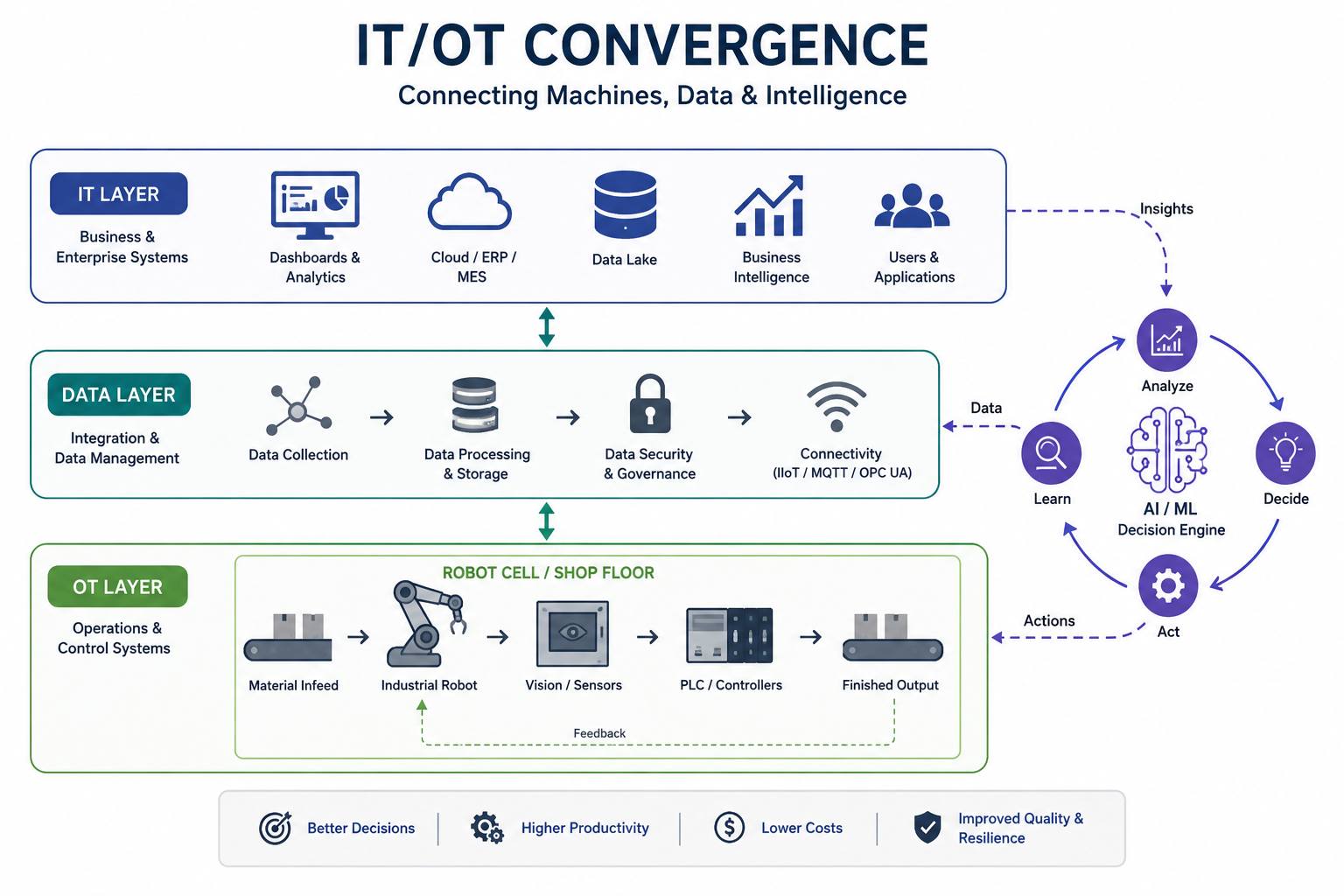
2. Convergence of IT and Operational Technology
Demand is rising for versatile robots that can be reconfigured quickly. Seamless data exchange between information systems and shop-floor control systems enables real-time analytics, better fleet management, and tighter integration with digital twins and manufacturing execution systems. This reduces the traditional isolation of robotic cells.
3. Humanoid Robots Moving Toward Reliability Proof Points
Humanoids attract significant attention and investment. Commercial platforms available for purchase or lease have increased, and pilot deployments continue in automotive and logistics settings. However, IFR and industry observers emphasize that most activity remains in trials and prototypes. Reliability, battery life, dexterity, safety certification, and total cost of ownership still require substantial progress before widespread industrial use.
4. Safety, Security, and Standards
As robots operate more frequently alongside people and become more autonomous, validation, testing, cybersecurity, and data privacy grow more complex. Standards development and rigorous human-oversight frameworks are becoming prerequisites for scalable deployment rather than afterthoughts.
5. Robots as Allies in Addressing Labor Gaps
Demographic shifts and skilled-labor shortages in manufacturing, logistics, and certain service sectors continue to drive adoption. Success, however, depends heavily on workforce acceptance and structured upskilling programs. Robots that simply displace workers without clear role evolution tend to face resistance.
Practical Applications Across Industries
- Electronics and semiconductors: High-precision assembly, handling, and inspection.
- Automotive and components: Welding, assembly, and increasingly flexible cells for mixed-model production.
- Logistics and warehousing: Autonomous mobile robots (AMRs) and mobile manipulators for goods transport and fulfillment.
- Life sciences, pharmaceuticals, and food: Clean-room compatible systems and packaging.
- Emerging: Medical robots and selected agricultural or inspection tasks.
Collaborative robots (cobots) and mobile platforms continue to grow faster than traditional industrial arms in percentage terms, reflecting the shift toward flexible, lower-volume, or human-shared environments.
Challenges and Limitations
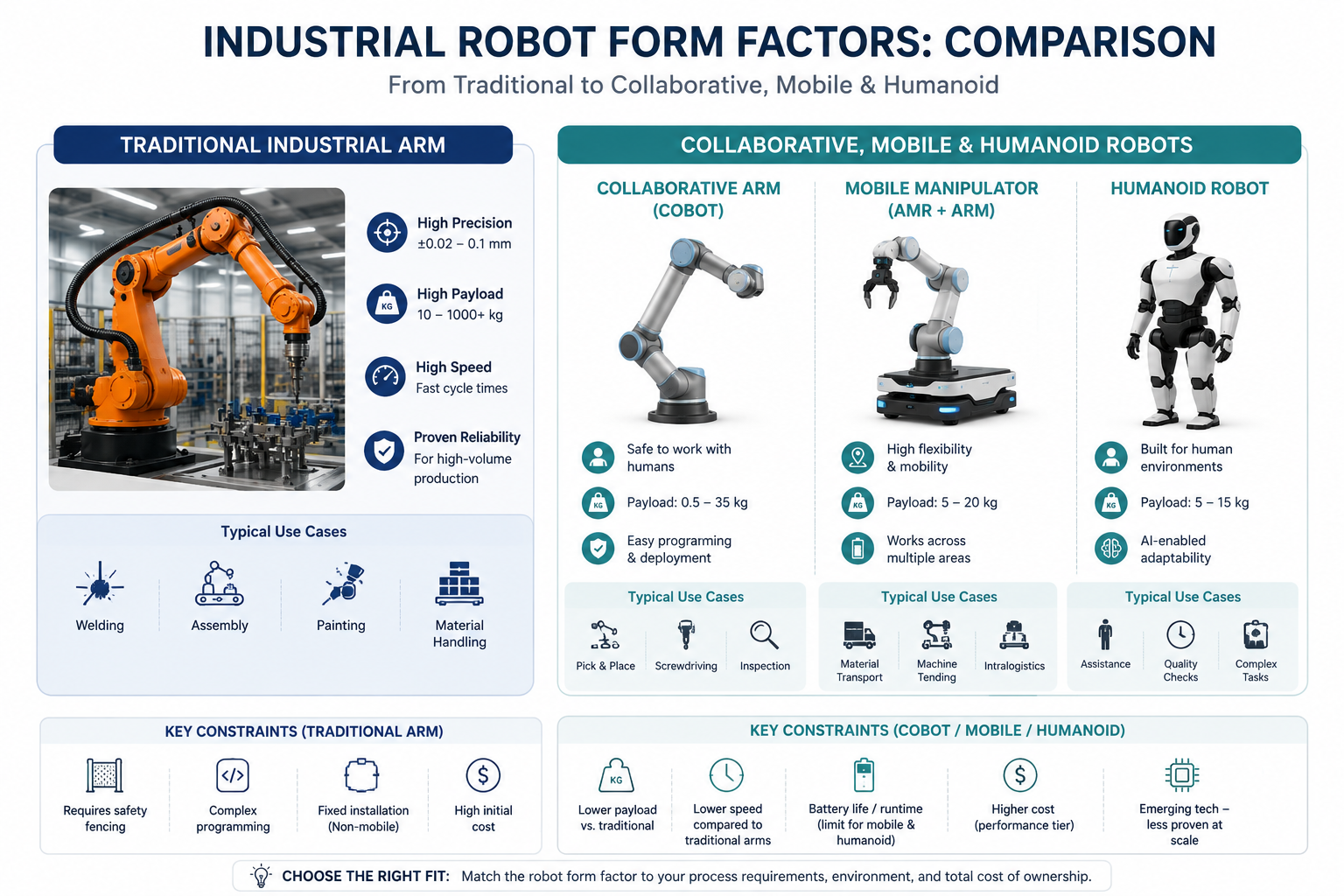
- Integration complexity and total cost of ownership: Hardware is only part of the expense; programming, peripherals, safety systems, and ongoing maintenance often dominate.
- Data and model requirements: AI-enabled systems need high-quality physical interaction data, which remains scarcer and more expensive than digital data.
- Skills shortage: Multiple analyses highlight acute gaps in perception/autonomy engineers, systems integrators, embodied AI specialists, and experienced robotics software talent. Senior and hybrid profiles are especially scarce.
- Organizational readiness: Successful programs require cross-functional ownership spanning engineering, operations, IT, and HR. Siloed approaches frequently under-deliver.
- Safety certification and cybersecurity: Especially for collaborative and autonomous systems.
- Regional and sectoral variation: Europe has faced softer demand in recent periods; automotive cycles still influence overall volumes.
What Organizations Should Focus On
- Start with clearly defined use cases that deliver measurable throughput, quality, or safety gains rather than technology-for-its-own-sake pilots.
- Invest early in integration architecture and data infrastructure for IT/OT convergence.
- Treat talent as a core workstream: map required skills (controls, perception, systems integration, AI deployment), build internal pathways, and partner for specialized leadership and engineering roles.
- Prioritize safety cases and cybersecurity from the design stage.
- Measure success with operational metrics (OEE impact, changeover time, defect rates) rather than robot count alone.
For organizations developing their industrial AI and smart manufacturing capability, robotics is a systems and workforce transformation—not an isolated equipment purchase. That makes engineering R&D talent, AI/ML engineering leadership, and the ability to scale Global Capability Centers central implementation concerns.
Outlook
Industrial robotics remains on a long-term growth path supported by labor demographics, reshoring and nearshoring pressures, quality demands, and technological improvement. Mobile robots and AI-enhanced systems are expanding the addressable market beyond traditional high-volume manufacturing. Humanoids will continue to generate headlines and selective pilots, but purpose-built and collaborative systems are likely to deliver the majority of near-term industrial value.
The companies that will extract the most from this cycle are those that pair capital investment with disciplined systems engineering and deliberate talent strategies. To discuss the specialist capabilities needed for a robotics programme, contact our team.
Frequently Asked Questions
What is the current size of the global industrial robot market?
In 2024, 542,000 industrial robots were installed worldwide according to the IFR, with installation value reaching a record $16.7 billion. The broader robotics market (including service and emerging categories) is estimated by various research firms in the $50–80 billion range for 2025, depending on scope.
Which country installs the most industrial robots?
China, with 295,000 units in 2024 (54% of the global total). Its operational stock exceeded 2 million units.
What are the top robotics trends for 2026 according to the IFR?
AI-driven autonomy, IT/OT convergence for greater versatility, progress toward reliable humanoids, heightened focus on safety and security, and the role of robots in addressing labor shortages.
Is the automotive industry still the largest user of industrial robots?
No. In 2024 electronics overtook automotive as the largest application sector by installations.
What is the biggest non-technical barrier to robotics adoption?
Talent and organizational readiness. Specialized engineering skills in autonomy, systems integration, and AI-robotics hybrids remain scarce, and many programs underestimate the change-management and upskilling required.
How fast is the robotics market expected to grow?
IFR projects industrial robot installations to grow at roughly 6% in 2025 and average around 10% annually through 2028. Broader market forecasts from commercial research firms generally fall in the mid-teens CAGR range depending on included categories.