
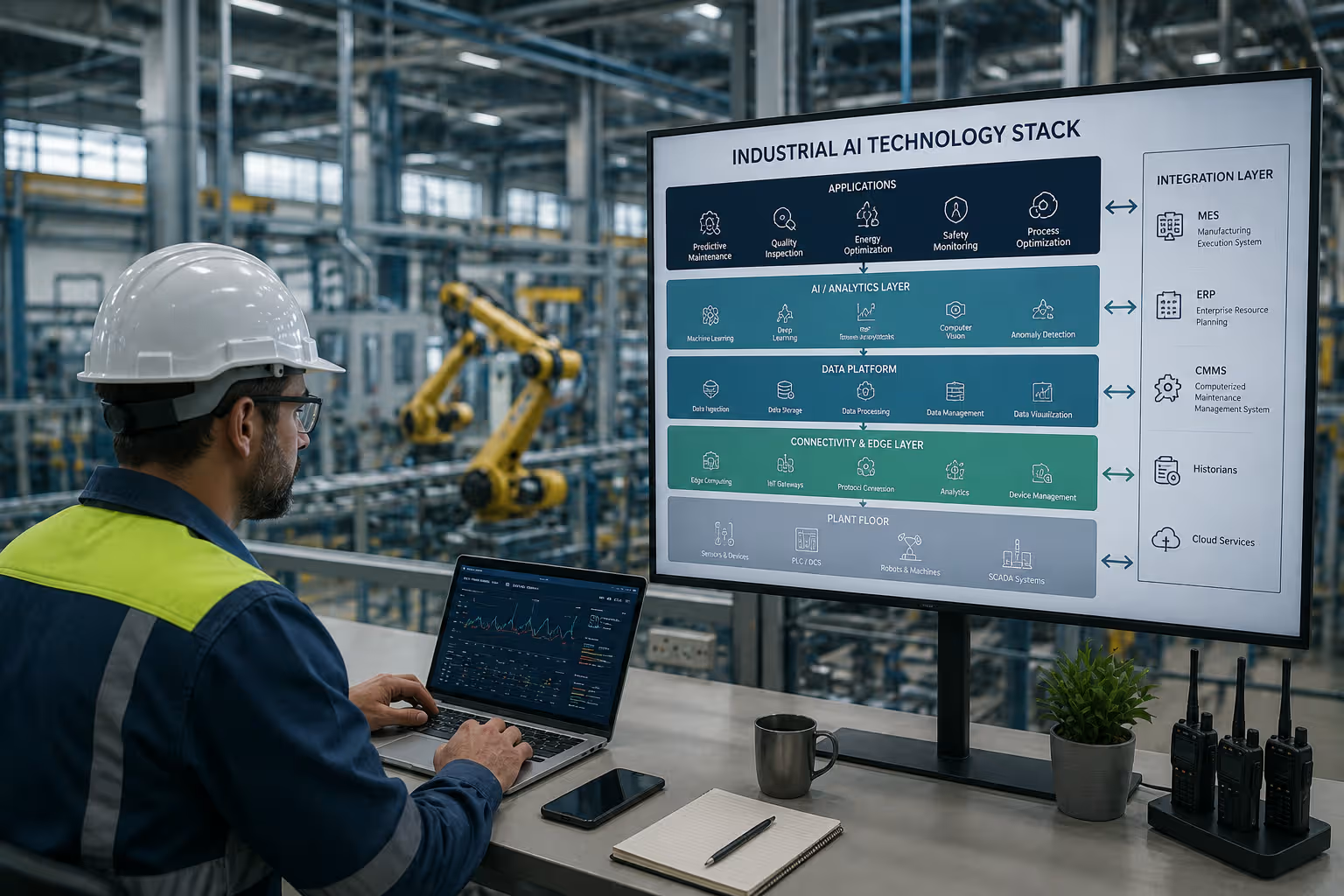
Industrial AI in Action: Real-World Applications Transforming Manufacturing in 2026
In an era of relentless global competition, supply chain volatility, energy price fluctuations, and rising sustainability mandates, manufacturers are turning to Industrial AI not as a futuristic luxury but as a core operational necessity.
Propellence Consulting's insightful presentation on Industrial AI in Action highlights five high-impact areas where AI is delivering measurable ROI today: Predictive Maintenance, Prescriptive Maintenance, Quality Inspection, Energy Optimization, and Safety Monitoring.
This blog dives deep into these applications, backed by 2026 market realities, adoption trends, challenges, and forward-looking insights.
The Broader Industrial AI Landscape in 2026
The global Artificial Intelligence in Manufacturing market was valued at approximately USD 5.3 billion in 2024 and is projected to reach nearly USD 48 billion by 2030, growing at a remarkable CAGR of around 46.5%.
Predictive maintenance subsets alone show strong momentum, with the broader predictive maintenance market expected to grow from around USD 15–17 billion in 2026 toward USD 40–97 billion by the early 2030s, depending on the source, at CAGRs of 24–28%.
Key Drivers in 2026
- Maturing IIoT and Edge Computing: Billions of sensors generate real-time data, processed closer to the source for low-latency decisions.
- Generative and Agentic AI: Moving beyond anomaly detection to prescriptive recommendations and autonomous workflows.
- Sustainability Pressure: Net-zero goals and energy costs push optimization use cases.
- Labor Shortages and Skills Gaps: AI augments human expertise in inspection and safety.
- Economic Uncertainty: The need to minimize unplanned downtime, which can cost thousands per minute, has never been higher.
Despite the hype, many initiatives still struggle with data quality, integration, and change management. Success stories come from companies that start with high-pain, high-ROI pilots.
1. Predictive Maintenance: From Reactive to Proactive
Core Idea (from the deck): AI analyzes sensor data such as vibration and temperature to identify potential failures before they occur.
Benefits include reduced unplanned downtime, extended equipment lifespan, lower costs, and improved reliability. An example is detecting abnormal vibration in motors.
2026 Reality: This remains the most adopted Industrial AI use case. Early adopters report 30–50% reductions in unplanned downtime. AI-driven predictive maintenance markets are expanding rapidly, with manufacturing leading adoption.
Insights
- Integration with existing CMMS/EAM systems is now table stakes.
- Edge AI enables real-time anomaly detection without constant cloud dependency.
- ROI is often realized within 6–12 months on critical assets such as rotating equipment.
Challenges: False positives can erode trust. Best practices involve hybrid models that combine physics-informed and data-driven approaches with human-in-the-loop validation.
2. Prescriptive Maintenance: Beyond Prediction to Action
Core Idea: Not only does AI predict failures, it also recommends optimal corrective actions, including timing, spare parts planning, and risk mitigation.
An example is suggesting bearing replacement within a specific maintenance window.
2026 Trend: The shift from predictive to prescriptive and increasingly autonomous maintenance is accelerating.
AI now integrates with inventory systems for just-in-time parts management and optimizes maintenance windows around production schedules.
Market Insight: This evolution is driving higher growth rates in advanced segments. Companies using prescriptive AI see not only uptime gains but also optimized resource allocation and significantly lower operational risk.
Pro Tip: Start with prescriptive recommendations on a few asset classes before scaling to agentic systems that autonomously schedule work orders.
3. Quality Inspection: Computer Vision at Scale
Core Idea: Real-time defect detection using computer vision reduces manual effort, human error, speeds up production lines, and boosts customer trust.
It identifies cracks, scratches, and assembly issues instantly.
2026 Status: This is one of the highest-ROI applications of Industrial AI.
Adoption is widespread across automotive, electronics, and consumer goods industries.
AI vision systems achieve superhuman consistency, especially on high-speed production lines.
Insights
- Multimodal inspection combining vision and sensor data is emerging.
- Generative AI is helping create synthetic training data for rare defects.
- Integration with automated sorting and rejection systems delivers end-to-end quality control.
This directly impacts brand reputation and warranty costs in an era of heightened consumer expectations.
4. Energy Optimization: AI Meets Sustainability
Core Idea: Continuous monitoring identifies waste and optimizes usage patterns across HVAC systems, compressors, and production equipment based on real-time demand.
The result is a dual benefit of cost savings and reduced carbon footprint.
2026 Context: With energy prices remaining volatile and ESG reporting mandatory in many regions, this use case has surged.
AI can deliver 10–30% energy reductions in targeted systems.
Deeper Insight: Digital twins combined with AI enable scenario modeling and "what-if" analysis for operational decisions.
Sustainability leaders are increasingly using these capabilities for Scope 2 emissions reporting and regulatory compliance.
Today's Condition: Hybrid cloud-edge deployments handle massive industrial data volumes while maintaining cybersecurity requirements in OT environments.
5. Safety Monitoring: Protecting People and Assets
Core Idea: Real-time hazard detection, PPE compliance, unauthorized access alerts, and faster incident response.
Examples include identifying missing helmets or restricted-zone breaches.
2026 Perspective: AI-powered safety systems are becoming standard across high-risk industries.
Computer vision and wearable integration are enabling proactive rather than reactive safety management.
Broader Impact: Beyond compliance, these systems contribute to lower insurance premiums, reduced lost-time incidents, and improved workforce morale, which is increasingly important amid ongoing talent shortages.
Implementation Roadmap and Challenges in 2026
Start Small, Scale Fast
Pilot on one production line or asset class with clearly defined KPIs such as downtime, defect rates, or energy consumption.
Data Foundation
Ensure clean, contextualized data. Many failures stem from poor data governance.
Change Management
Involve operators early. AI should augment human judgment, not replace it.
Vendor Ecosystem
Look for solutions with strong domain expertise, explainable AI capabilities, and seamless integration.
Talent
Demand for MLOps engineers, industrial data scientists, and domain-AI hybrid professionals remains high.
Common Pitfalls
Over-customization, ignoring OT cybersecurity, and chasing technology without business alignment continue to derail initiatives.
Propellence Consulting: Specialists in Building Industrial AI Teams
Propellence Consulting is a boutique global executive search firm founded in 2015, with offices in Pune, India, and Germany.
The firm specializes in recruiting high-impact engineering, R&D, and technical leadership talent across Automotive ER&D, AI/ML, Semiconductor, Smart Manufacturing, Robotics, and Deep Tech domains.
With over a decade of expertise, Propellence partners with Fortune 500 companies, Tier-1 suppliers, and innovative startups to scale technical teams, particularly for Global Capability Centers and cross-border initiatives spanning Europe, India, North America, and APAC.
Their deep domain knowledge in Industrial AI, predictive maintenance, Industry 4.0, and smart factories makes them a trusted advisor for organizations building the talent pipelines needed to turn AI pilots into production success.
Propellence doesn't just fill roles—they architect teams that deliver measurable outcomes in complex, mission-critical environments.
Their recent insights on Industrial AI Challenges in Manufacturing 2026 align perfectly with the practical applications highlighted in their presentation.
The Road Ahead
By late 2026, expect deeper integration across these pillars, creating intelligent, self-optimizing factories.
Organizations that combine robust technology with the right specialized talent will lead in resilience, sustainability, and competitiveness.
Propellence Consulting's work in this space, both through thought leadership and talent solutions, underscores a vital truth: Technology alone isn't enough. The right people make Industrial AI deliver results.
Ready to build your Industrial AI team or scale your smart manufacturing initiatives? Connect with Propellence Consulting at www.propellence.com .