

Forward Deployed Engineer: The Role Driving Enterprise AI Deployment in 2026
Enterprise AI initiatives often stall after the pilot stage. Models perform well in controlled environments, yet many organizations struggle to move them into production systems that deliver measurable business outcomes. This gap has created strong demand for a specialized engineering role: the Forward Deployed Engineer.
A Forward Deployed Engineer (FDE) embeds with customers, owns the end-to-end implementation of complex software or AI systems, and ships production-grade solutions inside the customer’s environment. The role combines software-engineering depth with customer-facing problem-solving and outcome ownership.
In 2026, Forward Deployed Engineer roles have become one of the fastest-growing and highest-compensated positions in technology. This article examines the current job market, compensation data, demand drivers, required skills, and practical considerations for both organizations and professionals.
What Is a Forward Deployed Engineer?
A Forward Deployed Engineer is a technical professional who works directly with customers to design, build, integrate, and maintain solutions using a company’s platform or technology. Unlike traditional software engineers who primarily build product features for many users, FDEs focus on making the technology succeed for specific customers.
Key characteristics of the role include:
- Direct customer engagement and discovery.
- End-to-end ownership of deployments.
- Production engineering: writing and maintaining code.
- Problem decomposition in ambiguous environments.
- Feedback loops that improve the core product.
The role originated at Palantir, where engineers known internally as “Deltas” embedded with government and commercial customers. In recent years it has expanded significantly across AI labs, data platforms, enterprise software companies, and consulting firms.
Why Demand for Forward Deployed Engineers Surged in 2026
Multiple independent trackers reported sharp growth in Forward Deployed Engineer postings. Year-over-year increases of 700% to more than 1,000% were observed in 2025–2026, depending on the data source and definition of the role.
1. High failure rates of enterprise AI pilots
Many organizations purchased or developed AI models but could not integrate them into secure, reliable production workflows. The bottleneck shifted from model capability to deployment and operationalization.
2. Complexity of real-world integration
Production AI systems require data pipelines, authentication, legacy-system connections, evaluation frameworks, monitoring, and compliance controls. These tasks demand engineers who can operate inside customer environments.
3. Shift in company strategy
AI labs and enterprise platforms recognized that pure product teams were insufficient. They began building dedicated deployment functions to accelerate customer value and revenue. The Forward Deployed Engineer role has consequently moved from a niche title associated with one company to a recognized function across AI infrastructure, vertical AI applications, hyperscalers, and professional services firms.
Forward Deployed Engineer Job Market Snapshot (2026)
Market data from multiple 2026 analyses shows hundreds of open roles at any given time, with counts ranging from several hundred to more than 1,300 depending on inclusion criteria and tracking methodology. Demand is concentrated among a relatively small group of high-volume employers, followed by a long tail of companies posting one or a few roles. The market has significant geographic spread, with strong demand in the United States and growing activity in markets including India.
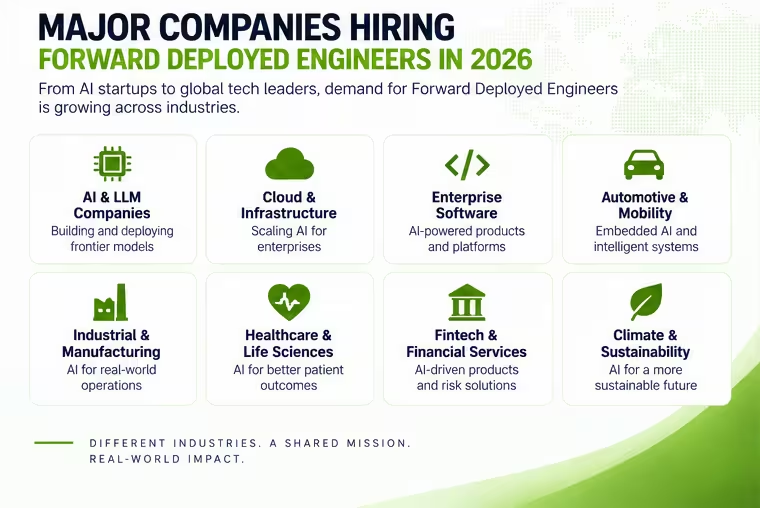
Titles vary: Forward Deployed Engineer, Forward Deployed AI Engineer, Applied AI Engineer, Deployment Strategist, and similar designations. Leading employers by volume or strategic focus in 2026 include Palantir, Databricks, Salesforce, Google, OpenAI, Anthropic, Scale AI, and a range of vertical-AI companies. Consulting organizations are also expanding hiring for equivalent profiles.
Compensation for Forward Deployed Engineers
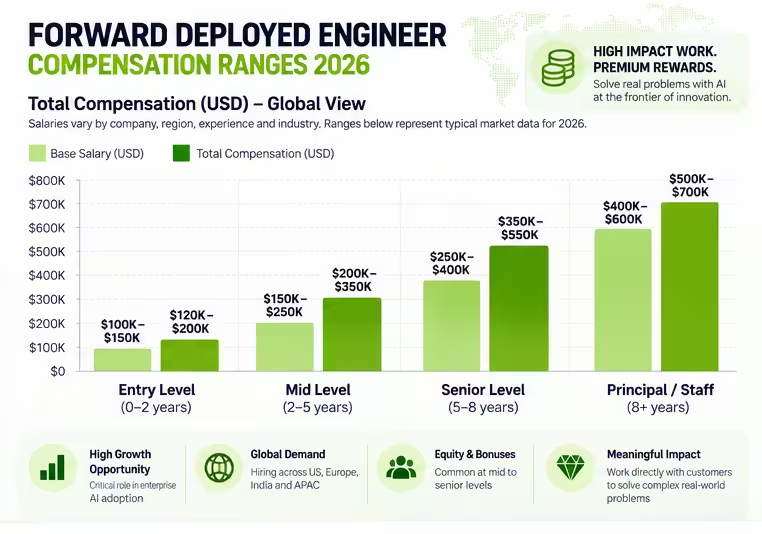
Compensation reflects the hybrid skill set and direct commercial impact of the role. Reported ranges in 2026 vary by company stage, seniority, and equity component.
- Mid-level: $220,000–$350,000 total compensation.
- Senior: $350,000–$550,000 total compensation.
- Staff / Principal at frontier labs: $600,000–$1,000,000+ total compensation.
Base salaries frequently fall in the $150,000–$250,000 range, with equity forming a substantial portion of packages at AI labs and growth-stage companies. Median figures from job-posting analyses and compensation platforms commonly land between $180,000 and $210,000 for base or midpoint total compensation, depending on the dataset.
In India, demand significantly outpaces supply. One 2026 analysis of the FDE talent landscape reported a large gap between employer demand (around 95%) and available talent supply (around 45%). Indicative compensation for forward-deployed AI builders started at approximately ₹32 lakh for early-career professionals and rose to ₹1.55 crore for highly experienced practitioners.
Skills and Profile That Employers Seek
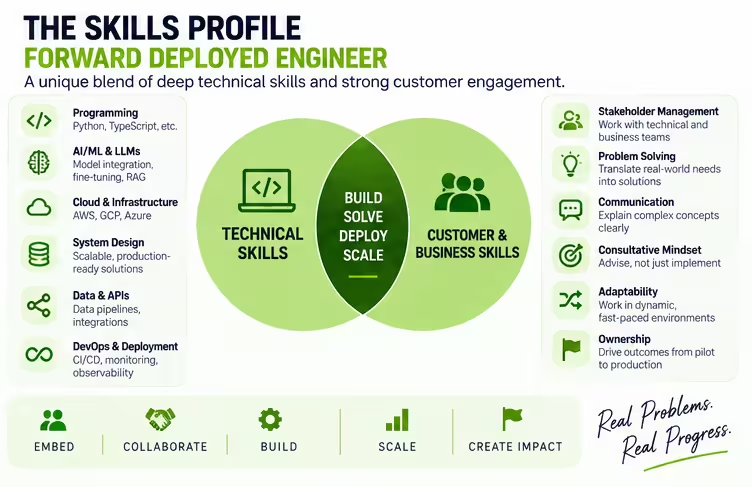
Successful Forward Deployed Engineers typically demonstrate a combination of technical depth and customer-facing capability.
Core technical requirements
- Strong production engineering skills, with Python frequently mentioned.
- API design and system integrations.
- Cloud platforms and infrastructure.
- Data pipelines and observability.
- For AI-focused roles: LLM integration, retrieval-augmented generation, evaluation frameworks, and agentic systems.
Non-technical differentiators
- Ability to discover and clarify ambiguous customer problems.
- Clear communication with technical and business stakeholders.
- Ownership mindset and comfort with incomplete requirements.
- Domain familiarity in financial services, healthcare, manufacturing, or government.
The scarce profile is an engineer who can ship reliable systems while operating effectively inside customer organizations.
Challenges of the Role
The Forward Deployed Engineer position carries notable demands: significant customer interaction and, in many cases, travel or on-site work; high ambiguity and pressure to deliver outcomes; the need to balance short-term customer needs with longer-term product feedback; and potential for burnout if travel intensity and ownership expectations are high.
Organizations should clarify travel expectations, support structures, and career progression paths when building FDE teams. Candidates should evaluate these factors carefully before accepting roles.
Implications for Organizations Building AI Capabilities
Companies deploying complex AI or enterprise platforms face a practical choice: invest in strong internal deployment capability or partner with specialized talent. Forward Deployed Engineers reduce the risk that expensive technology investments remain stuck in pilot mode.
For talent leaders, the role highlights a broader shift. The most valuable engineering profiles increasingly combine deep technical ability with the capacity to operate close to business problems and customer environments. Building AI/ML engineering talent, a resilient deep-tech talent strategy, and industrial AI and smart manufacturing capability needs to include this deployment layer. For senior hiring, specialist executive search for engineering roles can help identify the rare blend of production and customer-delivery experience.
How Propellence Supports Deep-Tech and AI Talent Strategy
Organizations scaling AI and engineering capabilities often need specialized talent that bridges product engineering and customer delivery. Propellence helps companies identify, assess, and engage engineering and AI professionals for high-impact roles, including emerging profiles such as Forward Deployed Engineers.
Conclusion
The Forward Deployed Engineer role emerged from a clear market need: closing the gap between AI capability and production value. In 2026, demand remains strong, compensation is competitive, and the skills required continue to evolve toward production AI systems and customer outcomes.
For engineers, the role offers high leverage and career optionality. For organizations, building or accessing this capability is becoming a practical requirement for successful AI deployment. To discuss an emerging AI or deployment-talent requirement, Contact Propellence.
Frequently Asked Questions
What does a Forward Deployed Engineer do day-to-day?
FDEs typically spend a substantial portion of their time engaging with customers (discovery, workshops, troubleshooting) and the remainder writing, integrating, and maintaining production code inside the customer environment.
How much does a Forward Deployed Engineer earn in 2026?
Total compensation commonly ranges from the low-to-mid $200,000s for mid-level roles to $500,000+ at senior levels in AI companies, with staff and principal packages at frontier labs sometimes exceeding $600,000–$1 million when equity is included. Ranges vary significantly by company and location.
Which companies hire Forward Deployed Engineers?
Major employers include Palantir, OpenAI, Anthropic, Databricks, Salesforce, Google, Scale AI, and a growing number of vertical AI application companies and consulting firms.
Is the Forward Deployed Engineer role only for AI companies?
No. While AI has accelerated demand, the model originated in enterprise software and continues to be used by data platforms, SaaS companies, and professional services organizations.
What background is best for becoming a Forward Deployed Engineer?
Strong production engineering experience combined with customer-facing or consulting exposure works well. Early-stage startup engineers, senior product engineers with customer work, and solutions engineers who code deeply often transition successfully.
Sources and context
Sources referenced are drawn from publicly reported 2026 market analyses and job-market trackers, including Rung, FDE Pulse, Perspective AI, Levels.fyi-derived data, Mint/FDE Academy India reporting, Business Insider/Indeed data, and related industry coverage. Posting-growth, compensation-band, and demand-supply figures are directional because methodology and role definitions vary between trackers.