
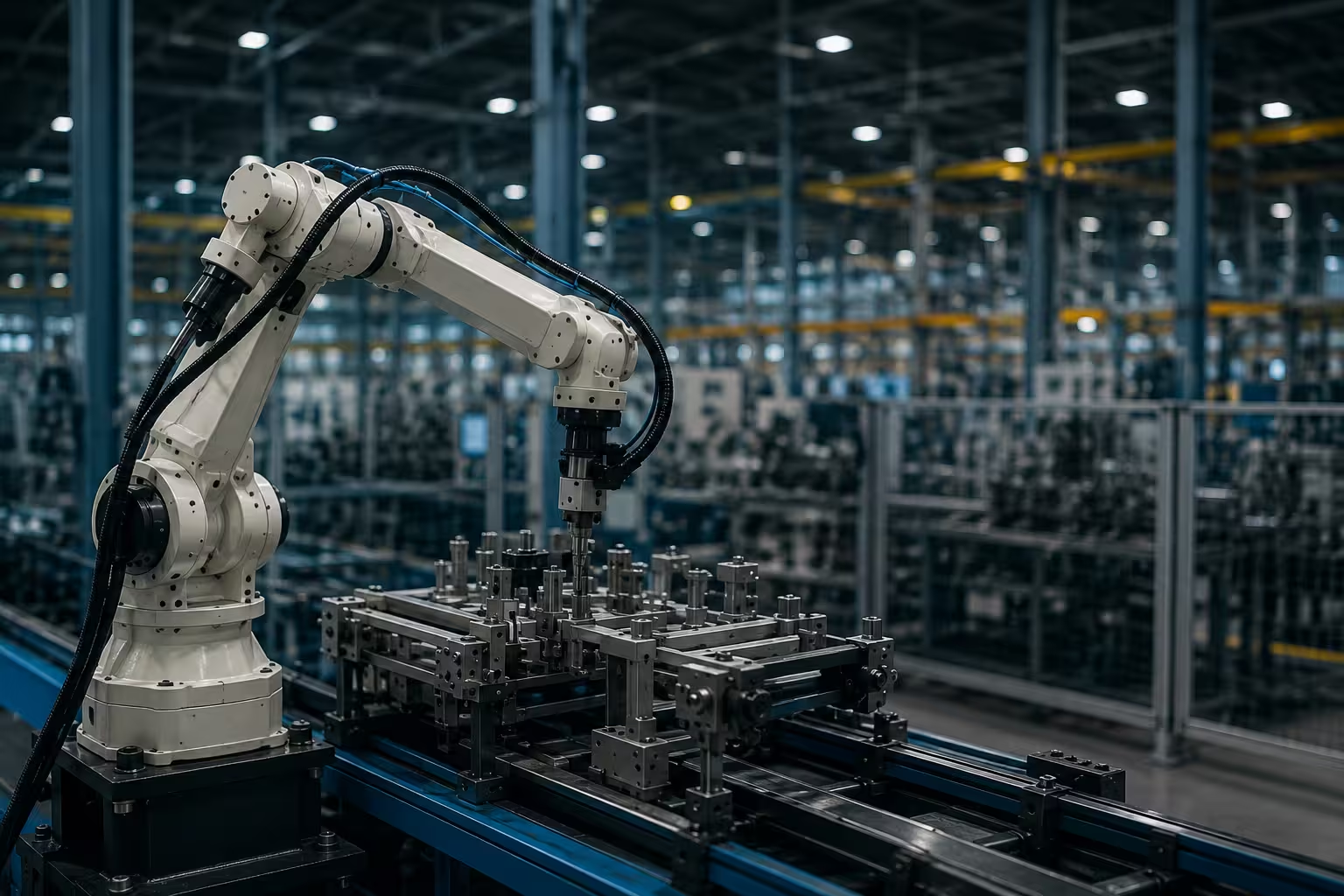
Advanced Industrial AI: Exploring Emerging Technologies and Future Industrial Trends
Industrial AI is transforming manufacturing, energy, and heavy industries by leveraging data from sensors, machines, and processes to drive efficiency, resilience, and innovation. Unlike consumer-facing generative AI, industrial AI prioritizes reliability, safety, real-time decision-making, and integration with physical assets in high-stakes environments.
This in-depth blog explores key topics: Machine Learning for Industrial Assets, Industrial Data Modeling, AI Deployment Challenges, Agentic AI in Manufacturing, Generative AI vs. Industrial AI, Digital Twin Intelligence, and Autonomous Industrial Operations. It draws on real-world case studies, statistics, and trends as of 2026.
1. Machine Learning for Industrial Assets
Machine Learning (ML) powers predictive maintenance, anomaly detection, and performance optimization for industrial assets like pumps, compressors, turbines, and production lines. By analyzing sensor data (vibration, temperature, pressure), ML models predict failures before they occur, minimizing downtime and costs.
Key Benefits and Data
- Predictive maintenance via ML can reduce maintenance costs by 30-40% and unplanned downtime by up to 50%.
- In a refinery case, AI-driven diagnostics yielded a 4x ROI within six months, with maintenance cost reductions exceeding 65% after one full year and 72% over two years. Specific interventions saved $120K–$300K per event while avoiding hundreds of hours of downtime.
- A cement manufacturer achieved 87% precision in failure alerts and $25M+ annual economic benefits through predictive insights on pumps, mills, and crushers.
- Utilities using ML for distribution transformers reduced failure rates by 2–3%, generating approximately USD 1.31M annual savings for 20,000 units.
2. Industrial Data Modeling
Effective industrial AI requires robust data foundations. Industrial Data Modeling involves contextualizing raw OT/IT data (time-series, logs, hierarchies) into semantic, unified structures for AI consumption.
Best Practices
- Adopt Unified Namespace (UNS) architectures for shared, contextual models over legacy point-to-point silos.
- Use medallion architectures (bronze/silver/gold layers) with governance, quality scoring, and lineage.
- Leverage standards like ISA-95, CESMII Smart Manufacturing Profiles, or ontologies for asset hierarchies and relationships.
- AI-assisted modeling (via LLMs) accelerates schema generation, validation, and optimization while requiring human-in-the-loop (HITL) for quality. Challenges include semantic gaps and data quality; solutions emphasize metadata, documentation, and hybrid human-AI workflows.
A strong data foundation enables scalable AI, reducing integration friction for downstream applications like predictive analytics.
3. AI Deployment Challenges
Despite promise, AI projects in industry face high failure rates due to integration issues, data problems, skills gaps, and unclear ROI.
Statistics (2025–2026)
- Approximately 80% of AI projects fail to deliver business value (RAND analysis of 2,400+ initiatives).
- 95% of generative AI pilots show zero measurable P&L impact (MIT).
- Only approximately 25% of enterprises have AI in production; fewer see strong results. PoC-to-production success is low (approximately 31% of firms see fewer than 5% of PoCs succeed).
- Manufacturing-specific hurdles include OT/IT integration gaps (71% data quality failures), regulatory explainability, skills shortages, and security/privacy concerns (top issues at 38–43%).
Overcoming Them
- Start with clear use cases, strong data foundations, and cross-functional teams.
- Use hybrid edge/cloud deployments, phased pilots, and focus on explainability/trust.
- Prioritize governance, change management, and measurable KPIs (e.g., OEE, MTBF, cost savings).
- Success stories emphasize vendor partnerships and iterative scaling over big-bang internal builds.
4. Agentic AI in Manufacturing
Agentic AI refers to autonomous systems that plan, reason, use tools, and execute multi-step workflows with minimal human intervention—evolving from predictive to action-oriented AI.
Trends and Adoption
- Market for agentic AI in manufacturing/industrial automation: approximately USD 5.5B in 2025, projected to USD 16.79B by 2030 (CAGR 25%).
- 56% of manufacturing executives using generative AI have agents in production (quality control 54%, production planning 48%, supply chain 47%).
- Deloitte: Significant growth expected; 24% of manufacturers anticipate use within two years (from 6%).
Use Cases
- Predictive maintenance agents, self-optimizing lines, workflow orchestration, R&D support, and robotics coordination.
- Examples: Boeing AI inspections/digital twins; BMW virtual factories; Aramco/Yokogawa autonomous control agents (15% amine/steam reduction).
- Agentic systems promise self-healing operations but require mature data infrastructure and governance.
5. Generative AI vs. Industrial AI
Generative AI (GenAI) creates new content (text, designs, code, synthetic data) from patterns, excelling in creativity and summarization. Industrial AI (often predictive/discriminative) focuses on optimization, prediction, control, and physical reliability using domain-specific, structured sensor/asset data.
Comparison
- GenAI: Strong for design ideation, documentation, troubleshooting chatbots, synthetic data. Flexible but prone to hallucinations; less reliable for real-time control.
- Industrial AI: Superior for classification, forecasting failures, process optimization on time-series data. More deterministic and explainable.
- Hybrid: GenAI augments Industrial AI (e.g., generating maintenance procedures from predictions or bridging gaps in design).
In manufacturing, traditional Industrial AI drives core operations (e.g., predictive maintenance), while GenAI accelerates innovation and knowledge work. Many deployments combine both for maximum value.
6. Digital Twin Intelligence
Digital Twins create virtual replicas of physical assets, processes, or systems, synchronized with real-time data for simulation, prediction, and optimization. "Intelligence" adds AI/ML for autonomous insights and scenario testing.
Market Growth
- Global Digital Twin market: Various estimates project explosive growth (e.g., USD 18.9B–36B in 2025 to hundreds of billions by 2030–2035, CAGRs 25–41%). Manufacturing is a leading segment.
- Benefits: 15–20% efficiency gains, 30–50% downtime reduction, better sustainability.
- Applications: Predictive maintenance, virtual commissioning, factory planning (e.g., BMW), energy optimization. Integration with AI, IoT, AR/VR, and agents enhances "intelligence."
7. Autonomous Industrial Operations
This vision integrates AI, robotics, digital twins, and agents for self-optimizing, low-intervention factories and plants—human-on-the-loop rather than in-the-loop.
Examples
- Yokogawa/Aramco: Reinforcement learning agents for gas plants (efficiency gains).
- AWS/SoftServe Hannover Demo: Fully autonomous production line with Autonomous Mobile Robots (AMRs), collaborative robots (cobots), and humanoid robots.
- Mining: Rio Tinto autonomous haulage systems have completed millions of kilometers while delivering significant productivity improvements.
- Broader Applications: Self-healing production lines, dynamic scheduling, robotic inspection, and autonomous maintenance.
Key drivers behind autonomous industrial operations include labor shortages, increasing safety requirements, and the need for higher operational efficiency. However, organizations must still overcome challenges related to data maturity, safety validation, and system integration.
Conclusion: The Road Ahead
Advanced Industrial AI is moving from pilots to scaled impact, with agentic systems, intelligent twins, and autonomous operations at the forefront of industrial transformation.
Success hinges on robust data foundations, hybrid approaches that combine predictive, generative, and agentic AI, cross-functional execution, and the ability to address deployment challenges proactively.
Organizations investing today in modern infrastructure, industrial data platforms, AI talent, and responsible AI governance will lead the next industrial revolution—delivering higher productivity, greater sustainability, improved resilience, and long-term competitive advantage.
The future is data-driven, autonomous, and intelligent. Start with high-ROI use cases such as predictive maintenance, build robust industrial data models, and scale iteratively while continuously improving AI capabilities across the enterprise.